
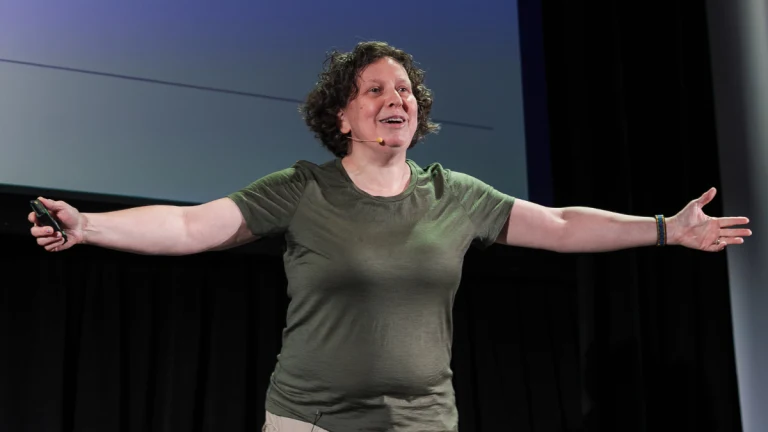
I had so much fun speaking at LeadDev NYC in October.
I wanted to submit a talk proposal for LeadDev LDX3 in London (in June!), but what to submit?
AI Interview
AI again, yep. I gave Claude the LeadDev submission guidelines, and told it I wanted to create a talk proposal relevant to my book, about which Claude already has a lot of information. I asked it to be encouraging, but to also suggest improvements if my ideas weren’t strong enough.
Then, not sure where to start, I asked it to interview me.
First, it had me give the “elevator pitch” for my book. I said:
The book is about the importance of embracing our full humanity while working in tech. The human skills many of us have been taught to ignore or dismiss as “soft skills” are essential tools for doing excellent technical work and avoiding burnout, plateaus, and isolation.
Skills like: building trust and influence, handling complexity and ambiguity, systems thinking, intuition and judgment based on experience, collaboration and communication, empathy, and creativity.
Next, it asked me for a story that illustrated that. The first story I thought of wasn’t all that relevant, but I wrote it out anyway just to get me writing.
By the time I was done with it, I had two more stories in mind. I could see the two stories were related. I wrote those out and sent just those two to Claude.
It suggested several angles I might consider, one of which stood out. After a lot of back and forth with more interview questions, I stepped away from it and wrote a first draft.

Uh oh.
Be editable
In her book-writing class, Luvvie Ajayi Jones said that we needed to be editable. Claude called me out: too generic and vague, completely omitted one of my main points, awkward third person style, stakes missing, no emotional punch…
Okay… I’m editable. I tried again. Second round was better, but still missing a lot.
Finally, I had the aha moment:
I’m trying to write both the talk proposal and the eventual conference website blurb. That’s not right. I need to let the reviewers in on some secrets that I might not want to reveal to the audience up front.
Revision three was much better. Claude still pointed out places where the writing was awkward or unclear. I gave it some of my own criticisms of the writing and asked it for ideas.
In the end, I used AI’s suggested wording in about one and a half sentences. The abstract is below - can you spot where I went with AI’s suggestions?
Here’s what I submitted:
Synopsis
I tried to be the hero. Fortunately, I failed. Here is how collaboration made our team stronger, and why AI makes collaboration more important than ever.
Abstract
(Max of 300 words!)
I was a newly minted senior developer when I took on the challenge of designing the architecture for my team’s new application. I had never before attempted something that big. I barely knew what I was doing.
But I wanted to be a leader, a hero. I set aside my self-doubt and stretched my limits. After a week of intense research and solitary effort, I showed the team what I had.
And our newest developer immediately identified fatal flaws that made my design unworkable.
Fortunately, I failed to be the hero. Instead, I learned that collaborative work beats solo heroics.
A few years later, I remembered that lesson when I faced a similar challenge as a tech lead. Yet I still felt pressure: I’m the tech lead, isn’t it my job to be able to handle the big stuff on my own?
My manager said something that changed my view: “It’s Tech Lead, not Tech Do. You’re not supposed to do it all. You’re supposed to help the team work together to get things done.”
Regardless of your role, relying on others isn’t “cheating” or admitting inadequacy; it’s the essence of the work.
This lesson matters even more today. As junior roles grow scarce and AI becomes a demanding colleague, senior developers face more pressure, isolation, and burnout. We need human collaboration more than ever.
At this session, you’ll see what collaboration looks like in practice and how to build cultures that support it over hero worship.
But here’s the deeper truth: collaboration isn’t just a productivity tool. It’s how we bring our full humanity to our work—and that matters now more than ever.
What’s next?
Wish me luck for London!
Where else should I consider speaking? What else should I speak about?
Also this week…
I’m reading a piece by Dave Snowden, the author of the Cynefin framework, about systems thinking. I picked it up at the recommendation of… Dave Snowden.
Yep. I messaged him on LinkedIn, told him about my book and who I was reading (Donella Meadows; Peter Senge’s The Fifth Discipline), and asked for his advice on what to read. He was kind enough to reply.
“Fifth Discipline won’t help you, thats old style systems thinking,” he said. He provided a few links.
I’m only a few pages in, but it looks promising so far.
Drop me a note
I would love to hear from you. Hit reply and let me know what’s on your mind and how this week’s message landed with you. I read every email and reply when I can!
This newsletter is approximately weekly. I post it on my website and on LinkedIn
Know someone else who would enjoy this? They can subscribe here: https://www.beyondwritingcode.com/connect/
Thanks for reading!