
I don’t know about you, but my brain is TIRED.
This week: managing information overload, and protecting our brains from being melted by AI.
Trying to outline everything
What I’m “supposed” to be working on this month (according to my boss (me)) is my book proposal. Part of that is the book outline.
Just dump all the ideas for your book into one document. Group things into categories, which become your chapters. Organize them, and you have your outline. That’s the advice from book coach Luvvie Ajayi Jones.
And it works. I’ve done it. Twice, even. Maybe three times.
But my book focus has changed, and those old outlines are obsolete. And now, I have so many leads to follow, resources to read, scattered notes to collect, ideas to integrate… trying to brain dump “everything” into one document has been a mess.
Fortunately or unfortunately, I have stumbled upon a promising system.
Zettelkasten
Zettelkasten is a method of knowledge management for an individual. Zettel is German for a note or a slip of paper, and kasten means box, so Zettelkasten = slip box. It appears to have a storied history which I’m not going to read.
What I did read was this blog post from Candost, an engineering manager I crossed paths with recently on Rands Leadership Slack: Concluding My Struggle with Note-Taking Systems and Apps, Finally!
(Rands Leadership Slack is a wonderful, thoughtful community of (mostly tech) leaders. Join, if it sounds like your thing. If you do, DM me to say hello.)
Zettelkasten basics: One idea per note. Put the notes in your own words. Link notes to each other. Write, link, and tag, to help your future self.
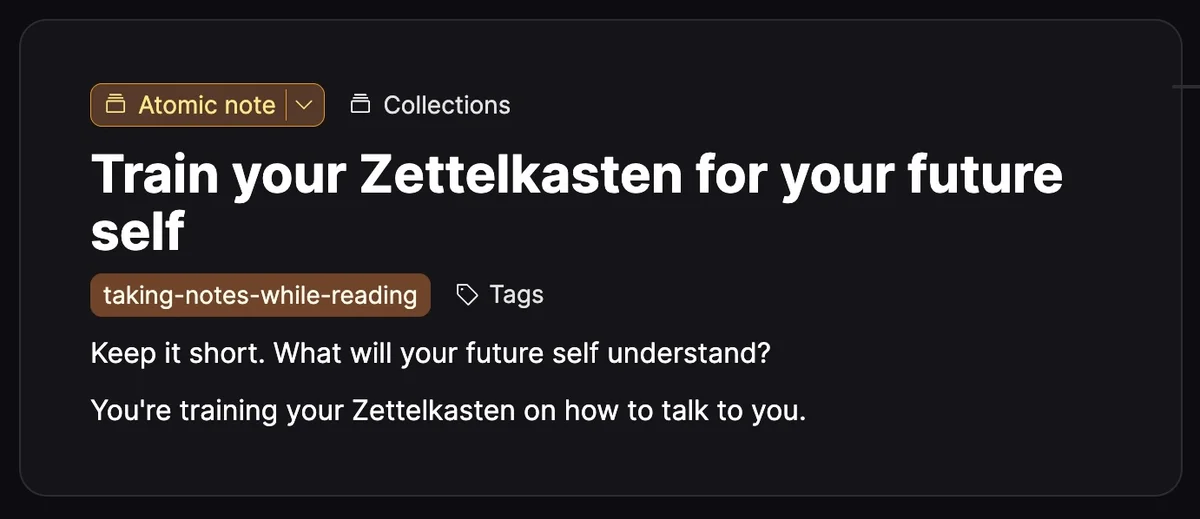
A zettel about using Zettelkasten.
I’m trying it out with ideas for the book. I’m using the software tool Capacities, but I don’t think the tool matters.
However, this just shifts the notes to a (very promising) structure requiring a ton of initial setup. When I’m done, I might have a highly useful set of notes, but in the meantime, this doesn’t make the staggering amount of information more manageable. Something else needs to change.
Changing how I read
Looking for advice about setting up Zettelkasten, I found this, which in turn led me to: The One Thing You Need to Learn to Fight Information Overload.
Let me tell you, these people know how to name their blog posts to get my attention.
It turns out to be more than “one thing.” But A Lengthy and Detailed Treatise on Fighting Information Overload just doesn’t work as a title, you know?
My takeaways:
Don’t just read something because someone gave it to you, or because it caught your eye. If it won’t answer a question you currently have, make you think, or be fun, don’t bother.
You can read for entertainment, for inspection, for understanding, or for expertise. Inspection is a quick read or skim. Understanding requires more time to think and integrate the knowledge. Expertise needs multiple sources for the same topic to get different perspectives, and you work to compare, frame the questions, etc.
A nice middle ground (when you’re not just reading for fun) is reading first for inspection. If you’ve got what you want out of it after a skim or a quick read of the introduction, move on. If it’s worth a deeper reading, mark passages as you go that you want to focus on. Then, reread for understanding, and focus on those marked passages only.
Okay, now we have a way of paring down the information coming in. This gives me some hope of getting through the items on my “to read for the book” list - not by reading them all and taking notes, but by being more selective about what I start reading and how much of it I actually read. Combine that with taking notes designed for future-me, and I think we’re getting somewhere.

Photo by Tim Wildsmith on Unsplash
I recommended an article to someone the other day, and she said something like “I’ll take a look at it and see if it’s something that fits my current goals.” Yes. That. I can’t just read everything that appeals, because it comes in way faster than I have time to dispatch it.
I spent some of my afternoon yesterday going through posts I had bookmarked. Some of them, I either just removed my bookmark or I took a zettel or two worth of notes and that’s it.
But when I saw an article by psychology researcher Cat Hicks about whether or not AI was melting our brains and what we can do to protect our thinking… I knew I had to read that one.
Protecting our thinking
Cognitive Helmets for the AI Bicycle, by Cat Hicks, starts with a question that’s been very much on my mind:
I hear people name these three fears: will developers lose their problem-solving skills, learning opportunities, and critical thinking?
She points out that, historically, people have said “it will melt your brain” about various events, from the introduction of radio and television… to women starting to ride bicycles.
She’s not dismissing the fears about AI. She just believes that “the explanation, and therefore the solution, is on the level of collective human behavior and our sociotechnical structures, not degrading myelin sheaths and fearmongering about cortical activity.”
The solutions she proposes so far (this article was Part One) have to do with 1) spacing our learning out over time rather than cramming, and 2) doing a quick attempt at a solution before having AI generate the solution.
To see her detailed suggestions, look for the bulleted lists in Cognitive Helmets for the AI Bicycle. This is a bigger topic than I want to dive into this week… but I wanted to give you a link to her article about it.
Be warned, though. The rest of her blog is interesting too. I’m going to have to be careful not to add all of it to the “read for understanding” list.
Things to read, or re-read
First, books I’ve read that I want to revisit. I want to go back and pull key ideas from these books into my Zettelkasten. (This section contains affiliate links for the books I’ve read.)
- Feel Good Productivity, by Ali Abdaal. Abdaal is a doctor who realized that “just work harder” wasn’t going to cut it in managing his intense workload. There had to be a better way. This book is about what he found, with research to back it all up.
- Today Was Fun: A Book About Work (Seriously), by Bree Groff. I want to prescribe this to everyone who is unhappy or overwhelmed at work.
- Do Nothing, by Celeste Headlee. Covers the history of how we got such pressure to overwork in the first place.
Three books I have on my to-read list. We’ll see if they get a quick reading or a deeper reading!
- The Reflective Practitioner, by Donald Schön. I’ve heard this mentioned several times as useful for working with complex systems, which sociotechnical systems certainly are.
- Antifragile, by Nassim Nicholas Taleb. This keeps getting mentioned in other things I’m reading.
- The Psychology of Software Teams. Cat Hicks has a book! It’s coming out sometime this year. So excited, if a little overwhelmed.
Drop me a note
I would love to hear from you. Hit reply and let me know what’s on your mind and how this week’s message landed with you.
Let me know also: Have you tried Zettelkasten? What strategies do you use for reading, note-taking, learning, or managing information overload?
I read every message and reply when I can!