
I made this post on LinkedIn the other day:
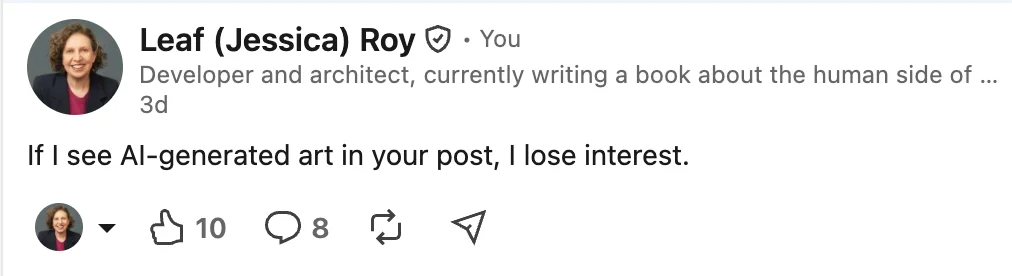
If I see AI-generated art in your post, I lose interest.
And I left this as a comment on it:
If your post or comments read like AI-generated content, I lose interest.
I like to read content from people who speak about their experiences in their own words. If I wanted an AI to tell me stuff, I’d ask an AI.
One of the commenters asked if I would mind AI-generated art “if the AI does a good job.” That got me thinking about why the AI art I see in posts was bugging me.
I might be treading on shaky hot water here (…what), but AI could be used to make innovative, creative art, just as artists have done with other kinds of technology. Just like a creative chef might make something special out of prepackaged meals, or a creative fashion designer might make something out of mass-produced clothes. But that’s certainly not what I see on LinkedIn.
I wonder if what’s bothering me (in this instance) about AI-generated stuff (LinkedIn post images, content, code) is a tendency to replace something human with something from the robot, without any apparent regard for the quality of that replacement.
People replacing human effort with AI often assume that AI can do the job as well as a human does, or at least adequately enough. The executive who vibe codes something over the weekend and insists that it is production-ready. The comments engineered for the algorithm and the “likes.” The AI-look comics that are suddenly everywhere.
Everyone who churns out books, music, or pull requests as fast as they can, hoping that enough of it will “stick” to make them some money. Everyone who says, “Why hire XYZ role when I can just have AI do it?” Everyone who says “why write my own posts when I can just have AI do it?”
In the case of work (rather than social media), these are often people who weren’t doing that work prior. Of course. MY work requires a human. Other people can be replaced.
It reveals whose work people don’t understand, or don’t value. The designer cuts out the developer, the developer cuts out the designer.
Sure, we might make our own jobs easier by automating tedious or time-consuming parts. We can use AI as a tool in our own work, the way a construction worker might use power tools or an accountant might use a spreadsheet. But we’re still running the show.
“Well, my work requires relationship-building, creativity, judgment, accountability, big-picture thinking, knowing what good looks like…” And other people’s work does not? I can’t speak for every career path, but certainly those are all important to the roles I’ve been in.
Now, prior to AI, unless we hired someone to do it for us, we generally created our own content and decorated our posts with our own art (photography, drawings, graphics, etc.) or someone else’s art that we chose (most of my posts have photos from Unsplash).
So what do we gain and what do we lose by having AI generate our social media content?
Maybe I could post more frequently if AI wrote my posts. Is that a good goal? Maybe I could drop my Unsplash subscription and save a few bucks by having AI make me photos. Is that a sufficient replacement?
Yet again, I find myself at the doorstep of my favorite question: “What are we even doing here, people?”
What’s the point of social media? (For us. I know what the point is for the social media companies.) What are we producing? Is the point of posting to build an audience so you have more people who might buy your product or hire you? To get dopamine hits from likes? To avoid Fear Of Missing Out?
Or do you just like reading the words of other interesting humans and seeing their creations?
I do sometimes wonder if LinkedIn will become a wasteland where nobody writes (it’s all AI), nobody reads (it’s AI replying), everyone has a zillion connections,” and nobody connects. Who knows, maybe we’d all step away from our social media feeds and get outside.
But in the meantime, I prefer human connection, made by sharing our own words and creations. And that’s the heart of the problem for me: when the bots are writing and making the images, I’m losing that connection.
Speaking of AI and writing, in the past, I’ve had AI review my newsletter and offer me feedback, which I might take or leave. I won’t let it write for me. The words are always mine.
But it might say things like “you brought up a point in the first paragraph but you never return to it” or “you have the word ‘of’ twice in a row in paragraph three” or “as usual, you sound like a motivational poster at the end.” Then I decide what, if anything, to do about that.
Starting with this post, I’m going to try dropping that. My eyes aren’t as sharp as they once were, so some typos may get through. But I’m hoping not even having the prospect of an AI reviewer will let me play a little more.
Drop me a note
I would love to hear from you. Yes, you. Assuming you’re not an AI. Hit reply and let me know what’s on your mind and how this week’s message landed with you.
I read every message and reply when I can!